FLOOD SOLUTIONS
Are You Prepared?


SPECIAL EDITION:
FLOOD SOLUTIONS
Florida Rainy Season Has Begun -
Are you prepared?
Florida’s official rainy season begins May 15 and continues through October 15 — bringing with it months of heavy rainfall, afternoon thunderstorms, king tides, localized flooding, tropical systems, rising groundwater, and growing concerns surrounding storm resiliency and aging infrastructure.
For many South Florida residents, this time of year can feel stressful, overwhelming, and uncertain.
Flooding today is no longer caused by just one issue alone. South Florida communities are increasingly experiencing what experts call compound flooding — when multiple flooding factors occur at the same time, including:
• Heavy rainfall
• King tides
• Rising groundwater
• Storm surge
• Sea level rise
• Canal and drainage system limitations
• Aging infrastructure
These overlapping conditions can place enormous pressure on neighborhoods, stormwater systems, roadways, canals, seawalls, and surrounding communities.
At many of our public outreach events, Residents for Resilience (R4R) continually hears residents asking questions like:
• Why is flooding getting worse?
• Why are streets flooding even on sunny days?
• What exactly is compound flooding?
• What can homeowners actually do to help protect their property?
• Are pumps and pipes enough?
• What are nature-based solutions?
• How can communities better prepare for stronger storms and rising water?
• What grants or funding opportunities may be available?
• What is the CRS (Community Rating System) and can it help residents?
These are important questions — and unfortunately, many residents are struggling to find clear, easy-to-understand information.
That’s where Residents for Resilience (R4R) comes in.
At R4R, our mission is to help fill the information gap between residents, scientists, engineers, environmental experts, educators, and government leaders — creating a space where communities can better understand the environmental and infrastructure challenges facing South Florida while also learning about practical, solution-focused approaches that can help.
Many residents are now beginning to hear more about FEMA’s Community Rating System (CRS) — a voluntary program that encourages communities to invest in flood mitigation, stormwater improvements, public outreach, emergency preparedness, and resiliency planning. Communities that actively participate in CRS programs may help reduce flood risk while also potentially lowering flood insurance costs for residents over time.
One question we hear continually is:
👉 “What can I do?”
The good news is — there are things residents, businesses, neighborhoods, and communities can do to help reduce flooding impacts, improve resiliency, and better prepare for future storms.
That’s why we’ve created this Special Edition Flood Solutions Page — to provide educational resources, ideas, updates, and practical information that we hope will help put your mind a little more at ease during these stormy, uncertain, and rapidly changing times.
Inside this special section, you’ll find information on:
🌧️ Flood mitigation strategies
🌿 Nature-based solutions
🛢️ Rain barrels & rain gardens
🌴 Native landscaping & tree canopy
🏡 Flood-resilient home improvements
🌊 Stormwater management
🦪 Living shorelines & oyster restoration
🚧 Infrastructure & resiliency planning
📚 Community resources & educational opportunities
💧 Water quality concerns
🌎 Environmental stewardship & sustainability
https://www.fema.gov/floodplain-management/community-rating-system
https://www.fema.gov/floodplain-management/community-rating-system
🌧️ What You Can Do This Rainy Season
Simple Ways Residents Can Help Reduce Flooding & Protect Water Quality
While large infrastructure projects are important, small actions taken by residents throughout our neighborhoods can also make a meaningful difference. Here are several ways homeowners, renters, businesses, and communities can help reduce localized flooding and protect South Florida’s waterways during the rainy season:
🌿 Replace Concrete & Rock Areas With Green Space
Natural landscapes help absorb rainwater and reduce runoff. Consider:
• Adding native plants or rain gardens
• Replacing unnecessary concrete or rock areas with permeable surfaces
• Expanding natural grass and landscaped areas where possible
🌧️ Install Rain Barrels
Rain barrels help capture stormwater runoff from roofs and reduce pressure on
storm drains while conserving water for landscaping.
🧹 Keep Storm Drains Clear
Help prevent street flooding by:
• Clearing leaves and debris near storm drains
• Reporting clogged drains to your city
• Never blowing yard waste into streets or swales
🛑 and...Never Dump Into Storm Drains
Storm drains flow directly into local waterways.
Never dump:
• Paint
• Oil
• Chemicals
• Pool water
• Yard debris
🌱 Protect Swales & Green Areas
Swales are designed to temporarily hold and absorb stormwater.
Avoid:
• Paving over swales
• Parking vehicles on them
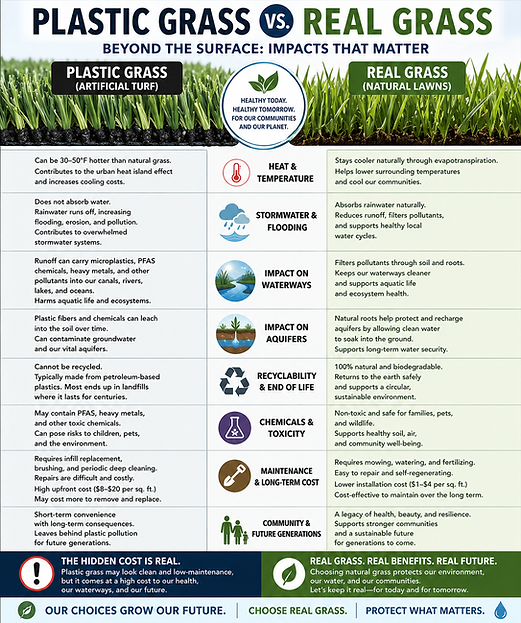
• Filling them with rocks or artificial turf
🌴 Plant Native Trees & Vegetation
Native trees and plants:
• Help absorb stormwater
• Reduce heat
• Improve soil stability
• Support pollinators and wildlife
🚫 Reduce Fertilizer & Chemical Use Especially During Our Florida Rainy Season
Everything that washes off lawns and driveways can eventually end up in canals, rivers, and the ocean.
Use fertilizers responsibly and avoid applying them before heavy rain events.
♻️ Opt for sustainable alternatives for Florida lawn care. It is crucial to adopt eco-friendly alternatives and sustainable lawn care practices to mitigate these harmful effects and protect Florida's unique environment.
By embracing organic alternatives, you can avoid harmful chemical residues in your soil, water, and food sources. Here are some alternative options to using chemicals on you lawn-
🍃Natural grass is significantly more effective than plastic (artificial) grass for flood mitigation. Natural lawns absorb thousands of gallons of water through deep root systems, whereas plastic grass acts like a semi-impervious surface that increases surface runoff by up to 50%.
🏡 Explore Flood-Resilient Home Improvements
Depending on your property, residents may want to consider:
• Permeable pavers
• French drains
• Rain gardens
• Elevating utilities
• Flood vents
• Improved drainage grading
🌊 Advocate for Nature-Based Solutions
Encourage local leaders to invest in:
• Mangrove restoration
• Living shorelines
• Resilient parks
• Expanded tree canopy
• Natural stormwater filtration systems
• Green infrastructure projects
📚 Stay Informed & Get Involved
Community awareness matters.
Attend meetings, ask questions, share information, and support organizations and initiatives
focused on long-term resiliency solutions.
🌿 Remember: Flood mitigation is not just about
pumps and pipes — it’s also about restoring natural systems that help absorb, filter, and
slow water before flooding occurs.
Together, small neighborhood actions can create a much bigger community impact.
🌧️ Rain Barrel & Rain Garden Tips
Small Changes That Can Make a Big Difference During Rainy Season
🛢️ Rain Barrel Tips
Rain barrels are a simple and affordable way to help reduce stormwater runoff while
conserving water for your yard and garden. They are shallow landscaped areas
designed to temporarily collect and absorb stormwater runoff from roofs,
driveways, sidewalks, and streets. Instead of water rushing directly into storm drains,
rain gardens help slow, filter, and naturally absorb rainfall back into the ground.
Benefits of Rain Barrels:
✔ Capture rainwater before it enters storm drains
✔ Help reduce localized flooding and runoff
✔ Lower outdoor water use
✔ Support healthier landscaping during dry periods
✔ Reduce pollutants washing into canals and waterways
Helpful Rain Barrel Tips:
• Place barrels under roof downspouts
• Use a screened top to help keep mosquitoes and debris out
• Elevate the barrel slightly for better water flow
• Add an overflow hose to direct excess water into landscaped areas
• Use collected water for plants, gardens, and landscaping
• Regularly clean gutters and screens to maintain proper flow
💡 Even one rain barrel can capture hundreds of gallons of water during a heavy South Florida rain event.
🌼Helpful Rain Garden Tips:
A Florida rain garden captures stormwater runoff to prevent flooding and pollution.
Key tips include placing it at least 10 feet from your home’s foundation and 25 feet from septic tanks,
and keeping depths between 4 to 8 inches to absorb water within 24 to 48 hours and avoid mosquito breeding
Benefits of Rain Gardens:
✔ Help reduce flooding and standing water
✔ Filter pollutants before they reach waterways
✔ Improve drainage naturally
✔ Support pollinators and wildlife
✔ Add beauty and native landscaping to neighborhoods
✔ Help recharge groundwater
Rain Garden Ideas:
• Use native Florida plants that tolerate both wet and dry conditions
• Position gardens where water naturally flows or collects
• Include deep-rooted vegetation to improve absorption
• Use mulch to reduce erosion and help retain moisture
• Avoid planting directly over utilities or septic systems
Great Native Plant Options May Include:
🌿 Muhly Grass
🌿 Blue Flag Iris
🌿 Firebush
🌿 Coontie
🌿 Native Milkweed
🌿 Simpson’s Stopper
💡 Rising sea levels push up the water table, which can make traditional, deep-dug
rain gardens act like soggy bathtubs. To adapt, build raised "bog" gardens to keep roots
above high groundwater. Design for overflow routing into pervious surfaces, and plant salt-
and inundation-tolerant native species.
Rain gardens do not need to be large to be effective — even small residential rain gardens
can help reduce runoff and improve neighborhood drainage.
🌊 Nature-Based Solutions Matter
Simple projects like rain barrels, rain gardens, native landscaping, tree planting,
and protecting swales can collectively make a significant impact in helping South Florida adapt
to heavier rain events and flooding challenges.
Flood mitigation is not just about pumps and pipes — it’s also about restoring natural systems
that help absorb, slow, cool, and filter water throughout our communities.